
The Franco-Mexican Mausoleum Through Time
Years after the Battle of Camarón:
The documents of verifiable authenticity, the historian’s treasure, are lacking in order to establish beyond dispute the antecedents of the current “Legionary Monument” of CAMARÓN. No doubt the archives of the British company that built the Veracruz-Mexico railway, crossing the now-famous hacienda less than a year after the battle and operating this line until 1939, contain details that would shed some light on this still obscure part of our small history. But several factors have so far prevented us from using this source of information.
We know that when Colonel JEANNINGROS and his legionnaires arrived at the hamlet of CAMARÓN at dawn on May 2, 1863, they discovered the bodies of our combatants carefully stripped, devoured by coyotes, and circled in the torrid heat by clouds of vultures. While Captain Danjou’s wooden hand was recovered and thereafter turned into a symbol of our martial valor, a common grave was dug outside the hacienda, very near the southeast corner, and the remains of the heroes were buried there. A simple wooden cross, placed upon the mound, became the first testimony, for passersby, of the sacrifices made in the struggle. According to a Belgian officer who rendered honors and decorated the tomb at the end of 1864, the inscription read as follows:
HERE LIES
The 3rd Company of the 1st Battalion of the Foreign Legion
Before the Expeditionary Force reembarked for France, but on an unknown date, a monument replaced the wooden cross, perhaps because it had not withstood the alternation of torrential rains and the tropical sun, but also no doubt because of its fragility. It was too modest for a tribute that was meant to endure. Let us listen to former Corporal MAINE: “Not far from there rises a mound topped by a broken column, around which a garland of laurels winds; there is no inscription, its glory makes up for it; it is the Mexican Government that bears the cost of its upkeep.” Several authors note that a small iron “barrier” or “grille” enclosed it. According to the Mexican commander Sebastián I. CAMPOS, “this monument was destroyed during the restoration of the republican regime by a sacrilegious and anonymous hand, that of a person who certainly understood patriotism as merciless hostility against the ashes of the heroes who had fallen in loyal combat.”
A third monument, essentially the work of Mr. Edouard SEMPÉ, French Consul in Veracruz, was erected—by public subscription—with the support of Mr. BLANCHARD DE FARGES, French Minister in Mexico City. It was completed in 1892. Its construction cost about 5,000 gold francs; the amount raised through private donations was supplemented by the budget of the Ministry of War (Service de Santé-Tombes). For some time, that same budget line covered the maintenance costs by assigning a monthly payment of 3 piastres, or about 150 gold francs per year, to a local resident. It seems that later the employees of the British railway company took charge of this until their company was purchased by the Mexican Government. The chosen site was about 5 meters east of the original common grave and about 6 meters from the station service track. It included a kind of funerary chamber with brick walls about 2 m long, 1.10 m wide, 0.80 m high, and 0.35 m thick, the upper part being very noticeably arched. This is where the bones from the first grave were transferred, mixed with earth from other places. Everything was covered by a rectangle of masonry at the center of which appeared a slab of very hard marble, measuring 1.70 x 0.70 m, bearing its already legendary inscription.
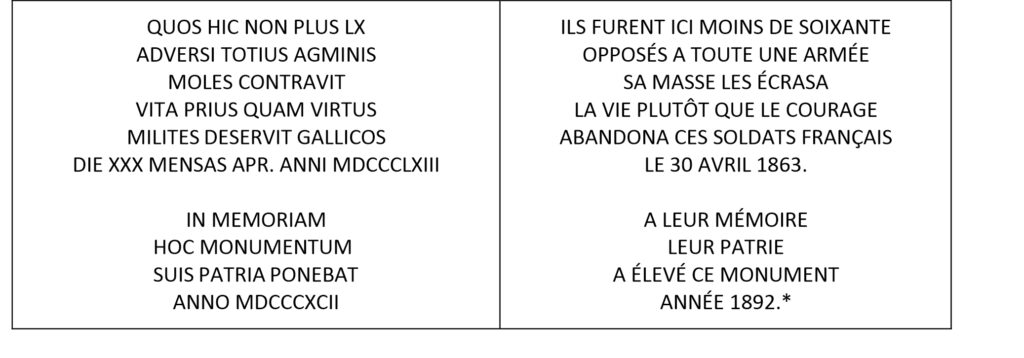
ERAN MENOS DE SESENTA CONTRA TODO UN EJÉRCITO, SU MASA LOS APLASTÓ.
THEY WERE FEWER THAN SIXTY AGAINST AN ENTIRE ARMY; ITS MASS CRUSHED THEM.
THEY FOUGHT UNTIL EXHAUSTION, UNTIL LIFE—RATHER THAN COURAGE—ABANDONED THESE FRENCH SOLDIERS ON APRIL 30, 1863.
IN THEIR MEMORY, THEIR HOMELAND
ERECTED THIS MONUMENT IN THE YEAR 1892.
This slab rested on a base whose two longer sides were chamfered, with an approximate height of 0.20 m at the front and 0.40 m at the rear, giving it a slight incline toward the visitor.
Around the masonry, rows of flat, square bricks measuring 0.40 m on each side gave the whole a dimension of about 5 x 3.75 m; a wrought-iron gate approximately 3.40 m long, 1.80 m wide, and 1.60 m high completed the general arrangement. Access to the interior of this enclosure was through a door wide enough for one person to pass, a feature that, beginning in 1954, was frequently used by those coming to lay floral offerings at the head of the slab. A “nacastle” tree, planted directly against the Monument on the eastern side, grew rapidly; in the early years of the century it covered the entire structure with its abundant branches. At that time, the surroundings were open, and only a few very modest houses could be seen here and there.
Colonel PÉNETTE’s Initiative:
The idea of erecting another mausoleum dates back to 1948, when Colonel PÉNETTE, a former Legion officer then stationed at the United Nations headquarters in New York, came to reflect at the site of the battle. He found the 1892 Monument in poor condition. The fence was loose and broken in several places, the gate jammed and impossible to open, rust spreading everywhere, small piles of earth forming on the slab, the bricks of the base coming loose, and grass bristling in the gaps. At times, the fence was used to tie up animals. The large tree had disappeared. The old caretaker appointed by the French Government had died a long time before, at a very advanced age, and had not been replaced. Three years earlier, the tomb had just been partially demolished to allow for the construction of a road. Everything pointed to abandonment.
This total neglect was not only visible in the facts; it also existed in people’s minds. No one in Mexico, neither at the French Embassy nor among the prominent members of the French community, could say exactly where Camarón was; almost no one had even heard of it.
Deeply dismayed by the contrast between the idea that, like every legionnaire, he had formed throughout his life of this historic site and the sad reality, and after having also kindly obtained from Mr. Robert de NOGARET, French Consul in Mexico, that the necessary repairs be carried out, Colonel PÉNETTE resolved to change this state of affairs and restore to this high place the prestige it deserved. But the results could only come to light very gradually.